
Mental Math Tricks Everyone Should Know
Improve speed and number sense with flexible mental strategies that work in school and everyday life.
Basic Math
Use patterns, small review cycles, and smart practice routines to remember multiplication facts with less stress.

Learning multiplication tables can feel overwhelming when students are asked to memorise a long list of facts all at once. The good news is that fast learning does not usually come from cramming harder. It comes from learning smarter. When students understand a few key patterns, practise in short focused bursts, and review the right facts at the right time, multiplication becomes much easier to hold on to.
Whether you are a student, a parent helping at home, or a teacher looking for a clearer approach, the goal is the same: make multiplication facts feel familiar instead of stressful. A calm routine works better than a rushed one.
If you are helping a child at home, use the examples in this guide as calm talking points rather than a script to rush through. The goal is to make the next step clear, lower pressure, and give your child language they can reuse independently.
Students often think they are bad at multiplication when the real problem is that the facts arrive as isolated pieces. A page full of facts such as 6 x 7, 8 x 9, 4 x 6, and 7 x 8 can look like a pile of unrelated answers. That makes the brain work harder than necessary. It has to store each answer like a separate object.
Strong learners usually do something different, even if they do not realise it. They connect facts together. They know that 3 x 4 and 4 x 3 are linked. They notice that 6 x 8 is close to 5 x 8, just one more group of 8. They remember that 9 x 6 is one group of 6 less than 10 x 6. Those connections are what make recall feel fast.
Speed is the result of understanding and review. It is not the starting point.
The quickest route into multiplication tables is to begin with the facts that already have visible structure. Doubles, fives, and tens are especially helpful because students can recognise them quickly. If a student knows that 5 x 6 means five groups of six, counting by fives or using money examples already gives them a useful anchor.
Start with facts in this order if possible:
This order matters because success early on creates confidence. Confidence makes later facts easier to approach.
Students do not need to learn both 3 x 8 and 8 x 3 as separate facts. Once they understand that the order of the factors changes the way the problem is written, but not the final product, the workload becomes smaller. Instead of memorising everything twice, they can focus on one fact family.
For example, if 7 x 4 = 28 is secure, then 4 x 7 = 28 is already done. This simple idea instantly reduces the number of facts that feel unfamiliar.
Long practice sessions often feel productive, but short daily review is usually much stronger. Five to ten minutes is enough when the practice is focused. A good multiplication routine should include recall, writing, and mixed review.
The mixed order matters because students should learn the fact itself, not just the rhythm of a list. If practice always runs 6 x 1, 6 x 2, 6 x 3, and so on, some learners remember the sequence rather than the facts. Mixed review forces stronger recall.
Keep a “hard facts” list with only five or six questions on it. These are the ones that need extra attention each day.
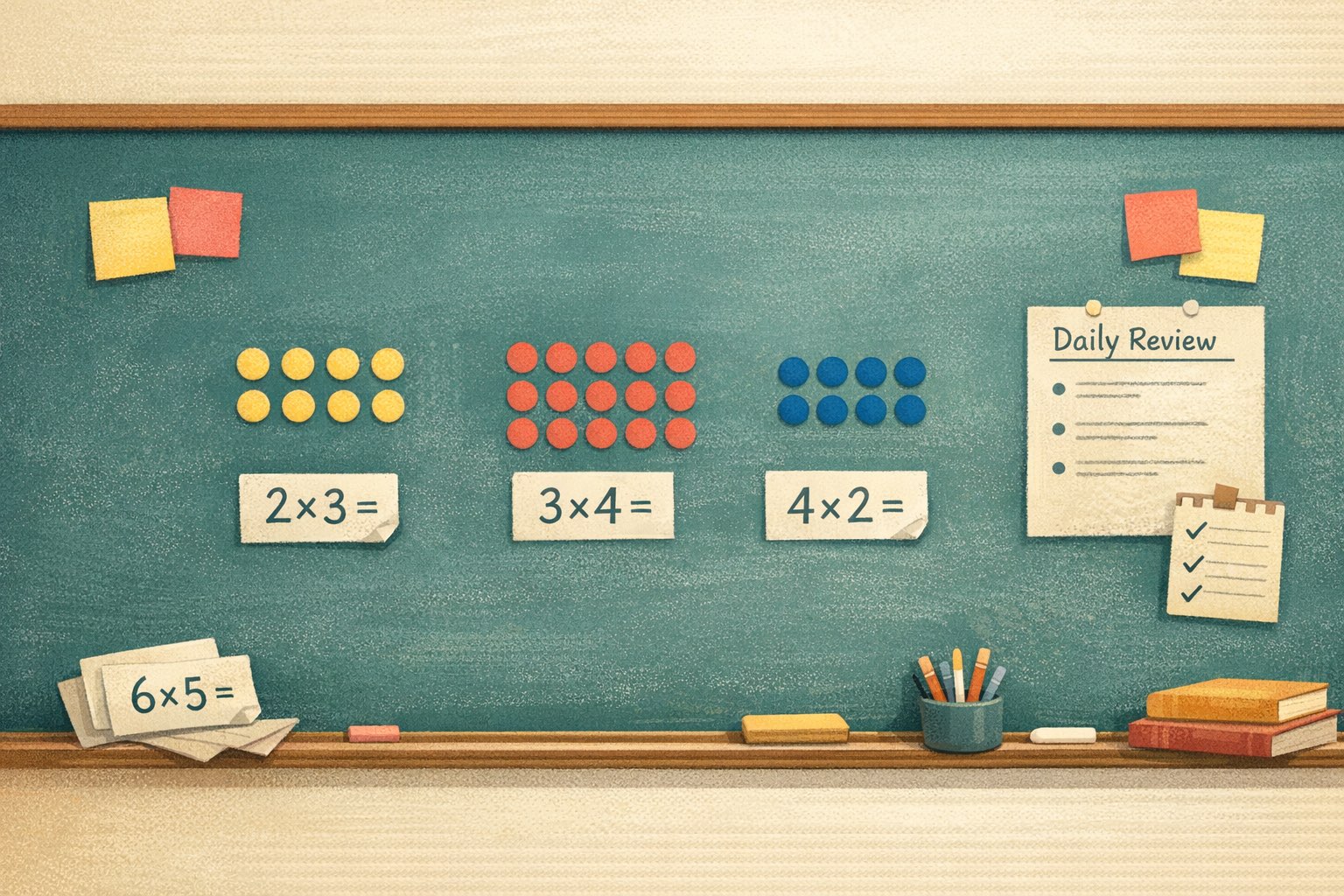
Multiplication becomes easier when students can picture groups, arrays, or area models. These do not need to be complicated. Even a quick sketch can help the answer feel less random.
Take 6 x 7 as an example. A student can picture 6 rows of 7 dots. They can also think of it as 5 rows of 7 plus 1 more row of 7. Since 5 x 7 = 35, one more group of 7 gives 42. That route is much easier to remember than trying to hold 42 in memory without a reason.
Another useful example is 8 x 6. A student might think of it as double 4 x 6. If 4 x 6 = 24, then doubling 24 gives 48. This kind of flexible thinking is what makes tables stick.
Good multiplication learning is not about finding one perfect trick. It is about giving students more than one safe route to an answer. If one route disappears under pressure, another one is still available.
Mistakes in multiplication practice are useful because they show where the memory is fragile. If a student keeps missing 7 x 8, that is not a sign of failure. It is a sign that one fact needs a stronger pattern attached to it. Maybe the student can connect it to 7 x 4 doubled, or to 8 x 7 as seven groups of eight.
When mistakes happen, avoid simply saying “memorise this better.” Instead, ask questions such as:
That turns an error into a thinking opportunity. It also helps students feel that multiplication is logical, not magical.
If you are supporting someone else, try to keep the emotional tone steady. Multiplication practice becomes much harder when every hesitation feels like a failure. Praise patterns noticed, not just answers produced. A student who says, “I knew 9 x 6 because I thought of 10 x 6 and took away 6,” is building exactly the kind of understanding that leads to long-term success.
Flashcards, quick oral quizzes, and timed review can all be useful, but only after the student has some structure to rely on. Timers should be used gently, not as a source of panic. Accuracy first, then speed.
The fastest way to learn multiplication tables is to stop treating them like a pile of disconnected facts. Start with patterns. Practise for a few minutes each day. Use visual models and nearby facts. Keep a short list of hard questions and revisit them often. This approach feels calmer, but it is also more effective.
Once multiplication facts feel more stable, students can use them in larger problems with much more confidence. If you want a next step, read Mental Math Tricks Everyone Should Know or How to Solve Math Problems Step by Step.
Improve speed and number sense with flexible mental strategies that work in school and everyday life.
A calm problem-solving routine for reading carefully, planning a method, and checking your work properly.

Use targeted practice sheets to revisit multiplication facts, patterns, and mixed recall.