Mental Math Tricks Everyone Should Know
Improve speed and number sense with flexible mental strategies that work in school and everyday life.
Mental Math
Learn chunking, doubling and halving, and near-ten strategies for bigger multiplication questions.
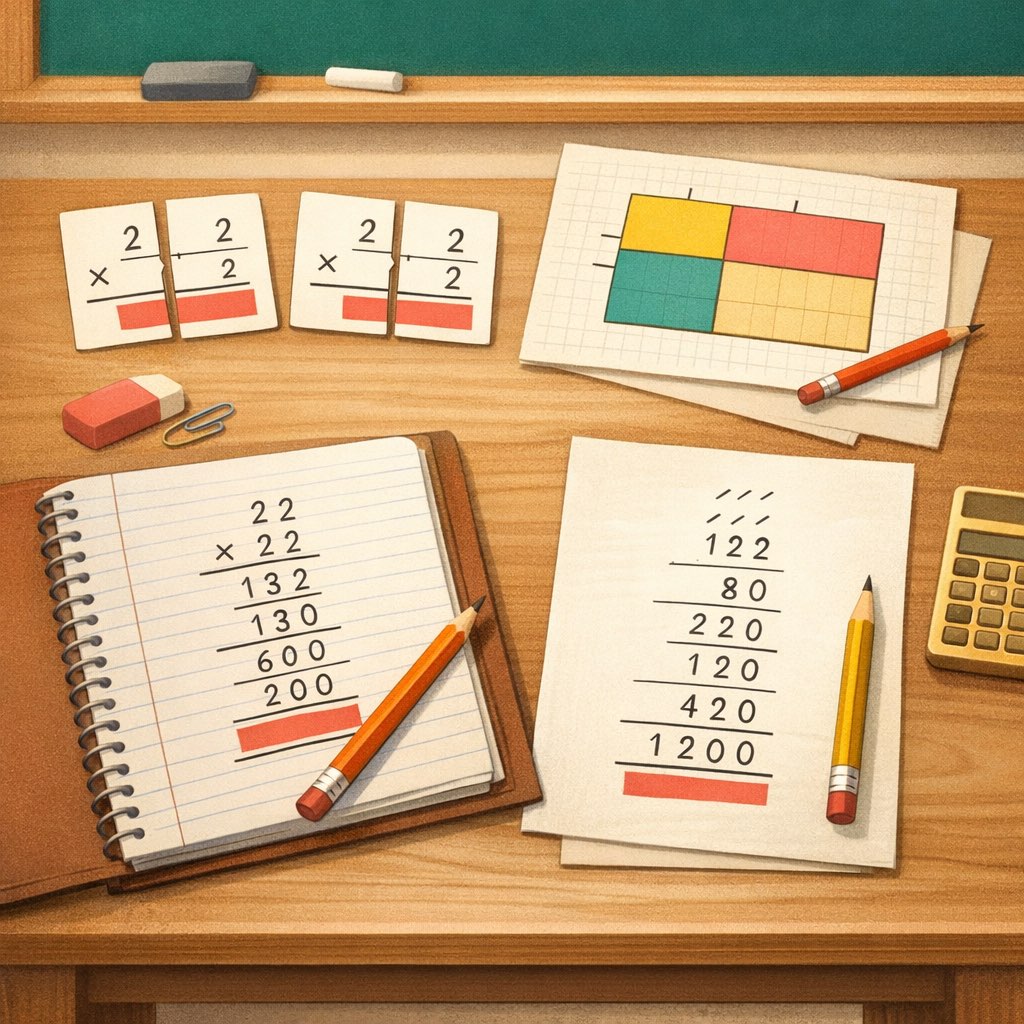
Large multiplication looks less frightening when students stop seeing the numbers as one giant block. The goal is not to show off or race through every question. The real goal is to notice structure, use friendly numbers, and make everyday calculations feel lighter.
The key is to use structure: split numbers apart, look for doubling and halving opportunities, and notice when one factor is close to a friendly number. With regular practice, these habits save time and reduce mental strain.
If you are helping a child at home, use the examples in this guide as calm talking points rather than a script to rush through. The goal is to make the next step clear, lower pressure, and give your child language they can reuse independently.
The key is to use structure: split numbers apart, look for doubling and halving opportunities, and notice when one factor is close to a friendly number. Strong mental math is less about memorizing dozens of tricks and more about seeing relationships between numbers. When students notice that 49 is close to 50, that 16 can be doubled and balanced, or that a problem can be broken into smaller pieces, they stop feeling trapped by the original form of the question.
This matters because many learners assume mental math means doing everything in one leap. In reality, good mental math is often a series of very small, sensible moves. Those moves become faster with repetition, but they start with understanding.
For 25 x 16, a student might double 25 to 50 and halve 16 to 8, then continue to 100 x 4. The answer stays the same, but the work becomes easier. When students hear that explanation enough times, they begin to look for simpler forms on their own.
For 19 x 23, students can think 20 x 23 and then subtract 23. That near-ten habit turns a harder fact into a simpler one. This is why place value and number bonds matter so much. They give students flexible pieces to work with instead of one heavy calculation to carry all at once.
It also helps to ask students what strategy they chose and why. Two students may solve the same problem differently and both be right. That variety is a strength, because it shows that math is about reasoning, not only copying one approved path.
After each strategy, ask why the move works. That keeps the trick connected to math structure instead of pure memorization.
One common problem is trying a shortcut without understanding whether it fits the numbers in front of you. If a strategy creates panic, it is probably too advanced for the moment. It is better to use a slower method that makes sense than a fast method that falls apart under pressure.
Students improve more when practice includes a small mix of addition, subtraction, multiplication, estimation, and number pattern work. That variety teaches the brain to choose a strategy instead of waiting for one familiar question type.
When learners explain their thinking, even briefly, they remember it better. A sentence such as "I rounded first and adjusted back" is often enough. It keeps the skill connected to reasoning rather than turning it into a trick that disappears the next day.
Practice a few multiplication questions each day and sort them by strategy: split, double and halve, or adjust from a nearby friendly number. A short routine works best because consistency matters more than long sessions.
Over time, students begin to recognize useful patterns faster. More importantly, they stop seeing mental math as a talent they either have or do not have. It becomes a skill they can train in small, steady steps.
Students usually become faster when they stop chasing speed directly. At first that sounds strange, but it is true. Speed is often the result of better pattern recognition, stronger recall, and more relaxed thinking. When learners understand why a strategy works, they do not have to rebuild the whole problem from the beginning each time. Their brain begins to recognize familiar number structures and respond more efficiently.
That is why low-pressure repetition matters so much. A child who works through a few carefully chosen questions every day often improves more than a child who does one long practice session once a week. Daily contact keeps the ideas active and gives the learner many chances to notice, "This problem is similar to one I solved yesterday." That feeling of familiarity is one of the main engines of mental fluency.
Progress does not only mean a faster answer. It can also mean choosing a better strategy, making fewer place-value errors, or explaining the method more clearly. When adults point out those small improvements, students stay motivated and stop thinking that mental math ability is something fixed from birth.
That approach keeps practice honest and sustainable. Students become quicker because their understanding is deepening, not because they are being pushed to rush before they are ready.
The best multiplication shortcuts are really ways of rewriting a problem into a friendlier form. For more support, read How to Learn Multiplication Tables Fast, How to Calculate Faster Without a Calculator, and Mental Math Tricks Everyone Should Know.
Improve speed and number sense with flexible mental strategies that work in school and everyday life.
Use place value, rounding, and estimation to make quick calculations feel more manageable.
A calm problem-solving routine for reading carefully, planning a method, and checking your work properly.